Published: November 24, 2025.
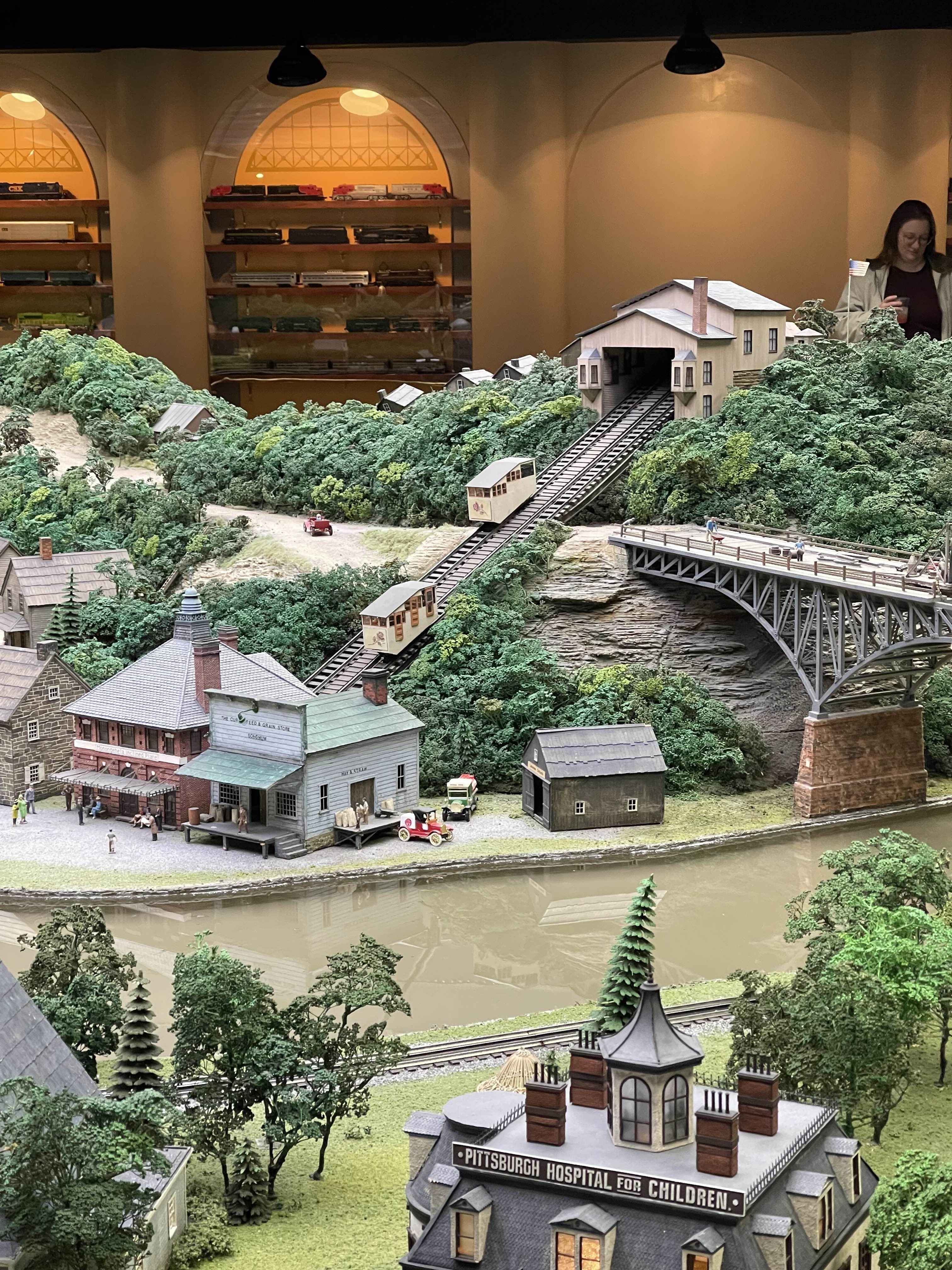
Consider this: It’s Friday, November 14th, and I’m in Pittsburgh’s newly-renamed Kamin Science Center. Amidst a sea of exhibits providing variations on the concept of “let children stack blocks with a plaque about the scientific method”, I stumble into a sight that rewires my brain chemistry. The Miniature Railroad & Village® is a 2,300 square foot train diorama with over a century of development, displaying a miniature version of the Pittsburgh of yesteryear. As I circle the exhibit in a state of wonderment and euphoria, I’m simultaneously overcome with a familiar sensation of longing: that I can’t spend the next 8 hours here, that my eyes are insufficient to take in the sights at the rate I wish, that I cannot be shrunk down to explore the mini-city at eye level. Or, put plainly in the words looping through my mind in the moment, “I want to be there”.
The famous (if you live here) Inclines... but small!
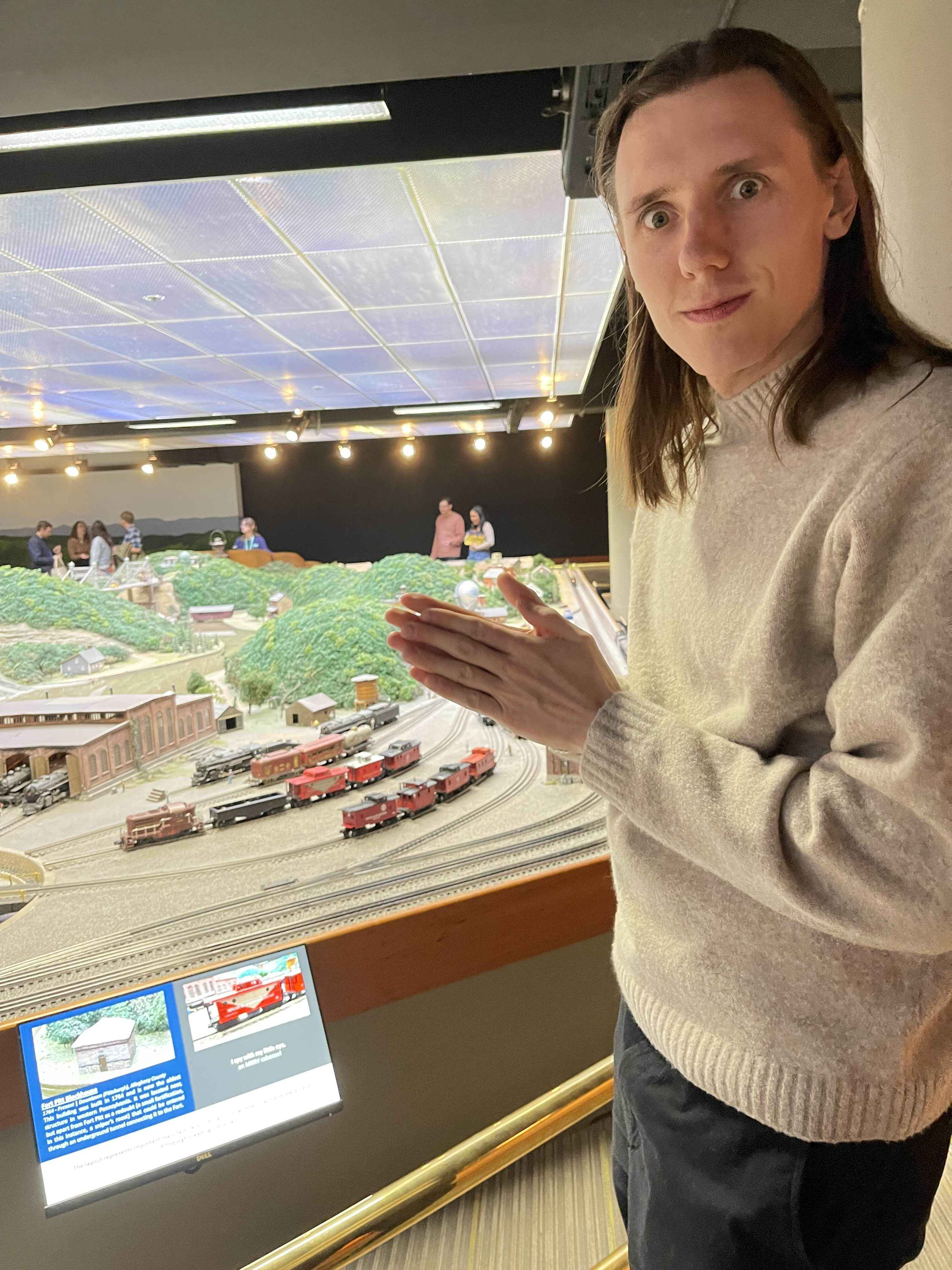
I'm actually not praying to the train gods, I was holding a marshmallow for Katrina and my fingers got sticky!
The above event is less “profound religious experience” and more a great case study to finally put a deep part of my psyche into words. What I’d like to do here is explore my relationship with miniature worlds, and the feelings of unattainability I associate with them. This will be phrased in very personal terms, as I can only speak to my own experience and doubt these emotions translate universally.
As a background/refresher, I am and always have been a lover of things handmade and small. LEGO, miniature/terrain modelling (wargaming, TTRPGs, etc.), stop motion, and intersections of those are perennial fascinations, and feel like something primordial in my brain. Despite my reluctance to assert these feelings for everyone, I recognize commonality in that children’s toys are built to small scale (given the logistical issues of trying to let a toddler operate full-sized construction equipment). So to hopefully touch on common ground between myself and other former children reading this, I’m going to use “Toy Towns” as a term to refer to the wide swath of environments and landscapes built in miniature.
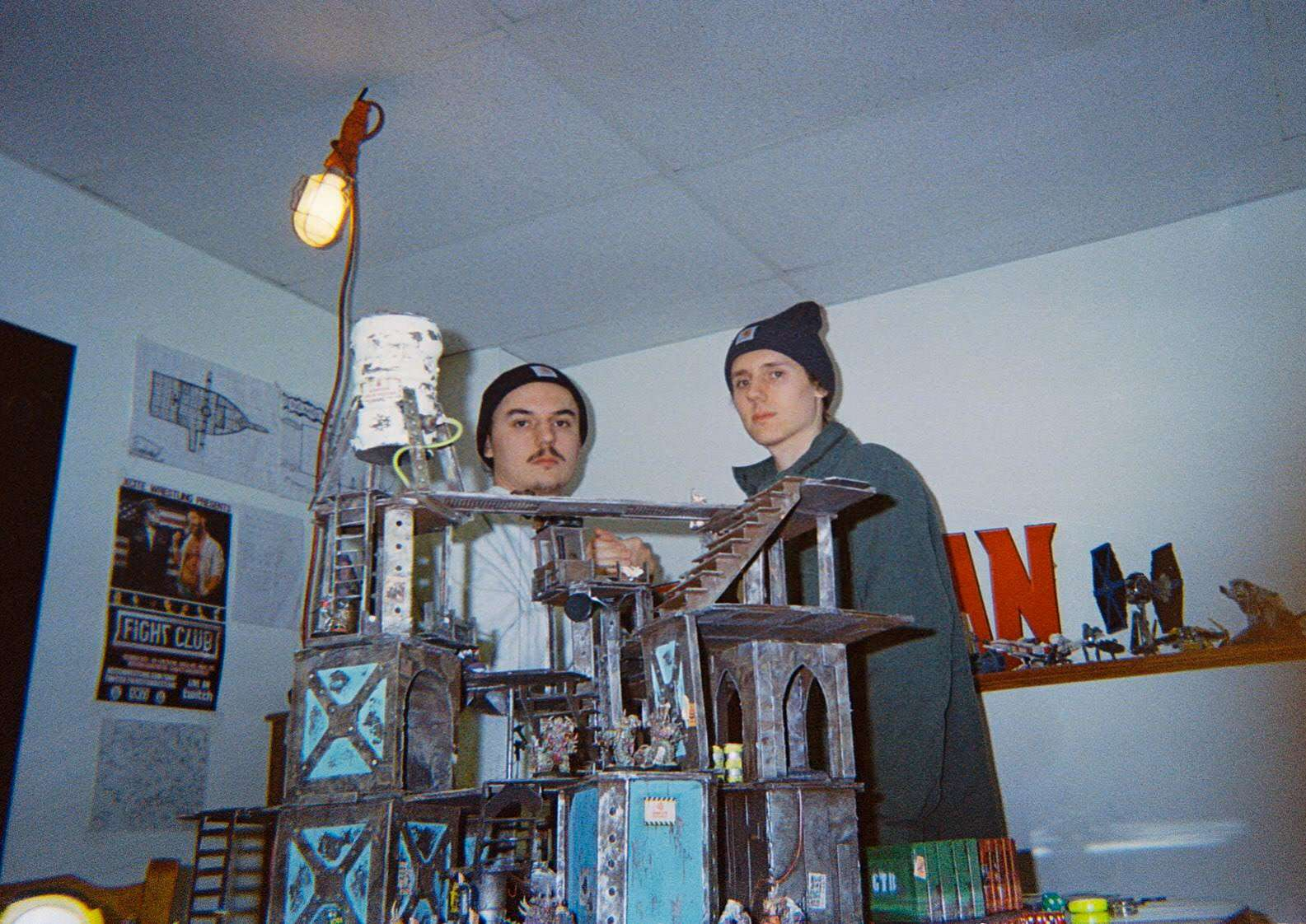
My brother, myself, and some of my modular wargaming terrain. 2021.
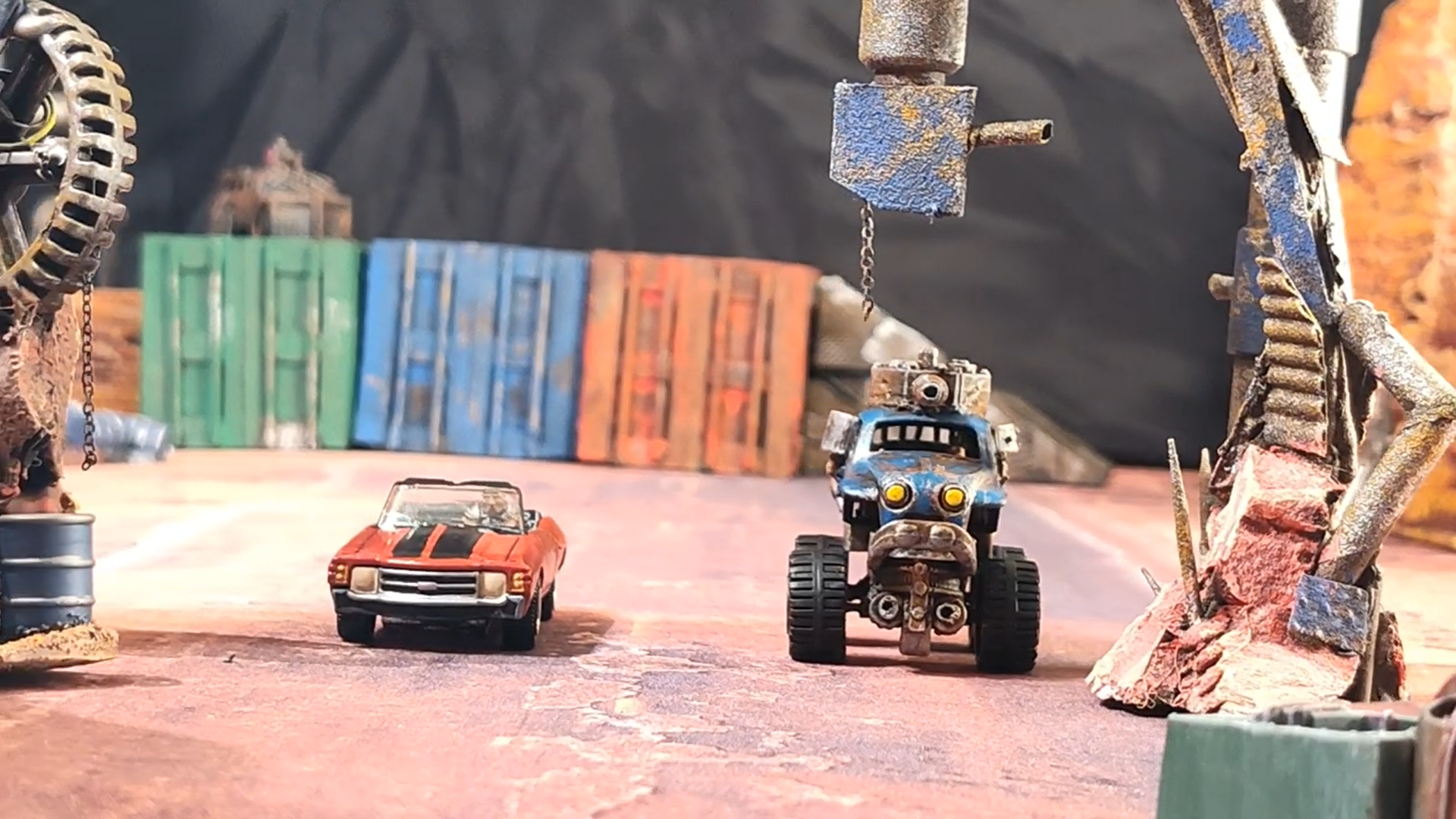
Still from my Gaslands Stopmo Project. 2025. Watch it at: https://youtu.be/t8OhW5AUIus?si=KYJrF0toiPaIgWRY
So to reiterate the situation, there is something about the tactile and analog nature of Toy Towns that gives me a craving to envelop myself within them like a tiny, fuzzy blanket. I believe this ineffable want of “more” stems from the separation of the complete realized world, and myself as an external Other. There is some barrier of immersion, a desire to explore and play that being a mere observer cannot satisfy.
It’s enough to make me wonder if this limbo is self-imposed, if the nature of this fantasy hinges on it being unattainable. I can feel my brain shifting the goal posts of what would make me feel sufficiently nestled within a Toy Town, and part of my motive for writing this essay is to develop my vocabulary into at least being able to identify this feeling, and ideally resolving it.
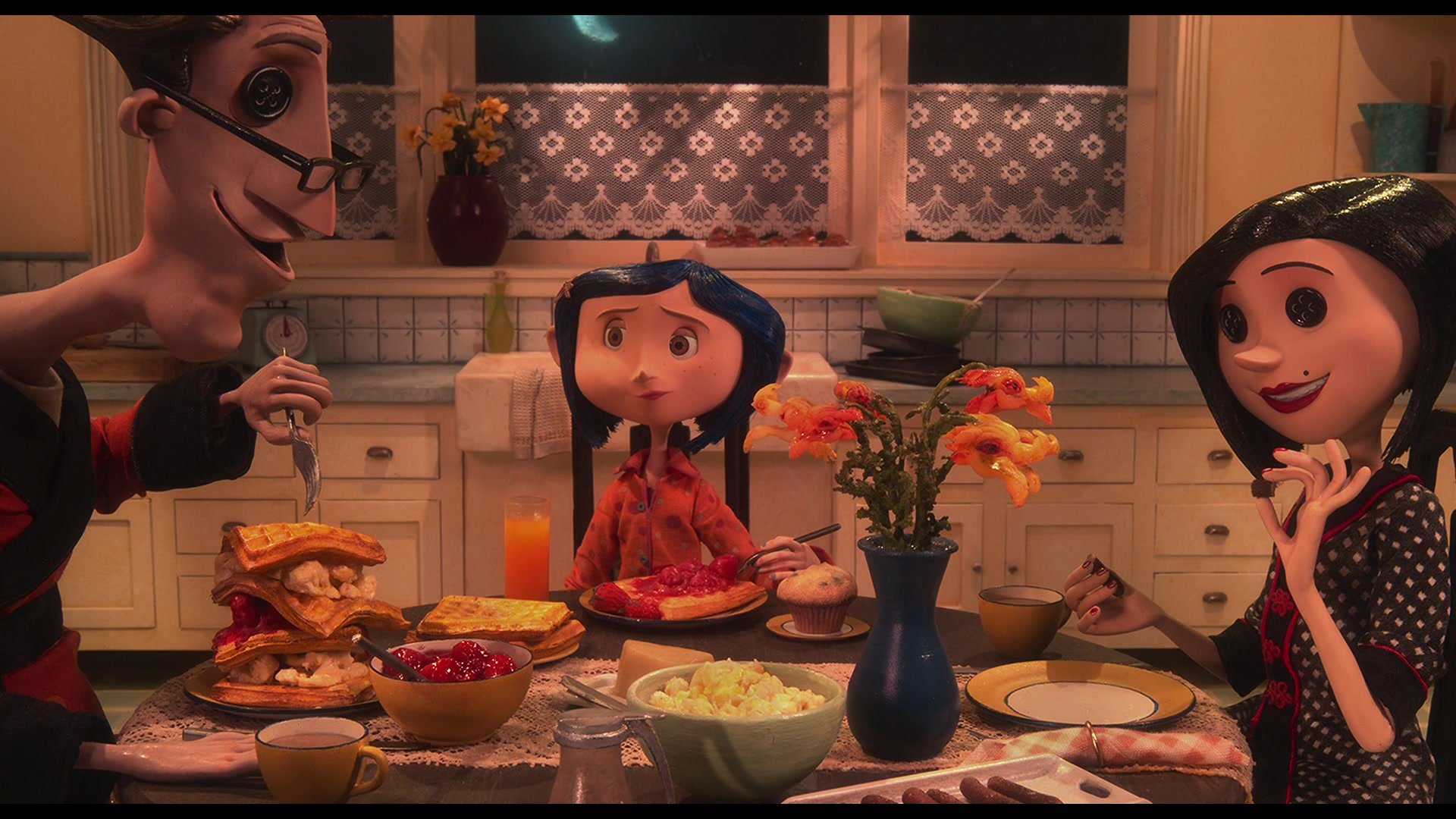
Coraline (2009). I want to crawl inside the screen and live here forever, despite the film taking a pretty strong stance against exactly that.
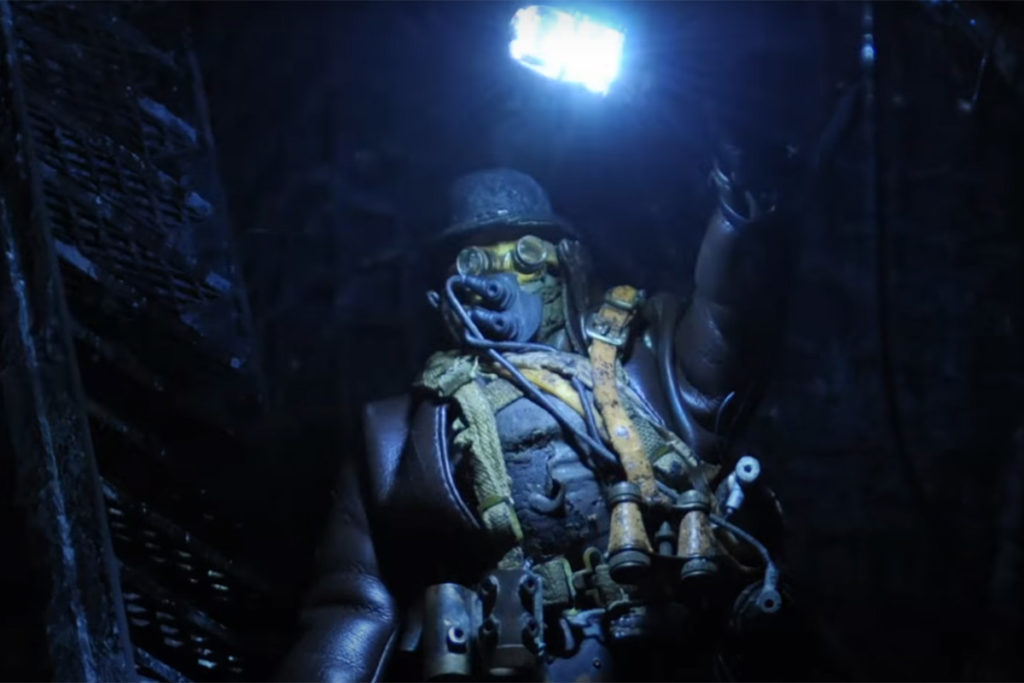
Mad God (2021) should be the most popular stop motion film but it didn't have the same cultural impact as Laika Studios films. Good, now I can gatekeep it.
At this point in my train of thought, I’m struck with a revelation: were a benevolent genie to shrink me down so I could reside in a whimsical Toy Town, the experience would remain unfulfilling. The rationale being that the realization of a fantasy would be boring (or would contain boring moments), as the process of reality is largely filled with mundane moments.
Case study: in The Lord of the Rings (books or movies, take your pick), long instances of travel can be condensed into a montage, giving the audience the portrayal of a journey without the same burden of time/effort. Conversely, in Lord of the Rings Online, an MMORPG I’m currently playing and enjoying, the simulationist nature of the open-world videogame means that I’m spending much of my time watching my character walk/ride from Point A to Point B, without the ability to cut to the next interesting scene. While the freedom of the videogame has its advantages in immersing me in Middle-Earth, that illusion is often broken as I watch the 5-second crafting animation repeat dozens of times as my character converts Brushed Pristine Leather into Pristine Leather Shavings and back again, to grind out enough crafting xp to become a Master Artisan Tailor.
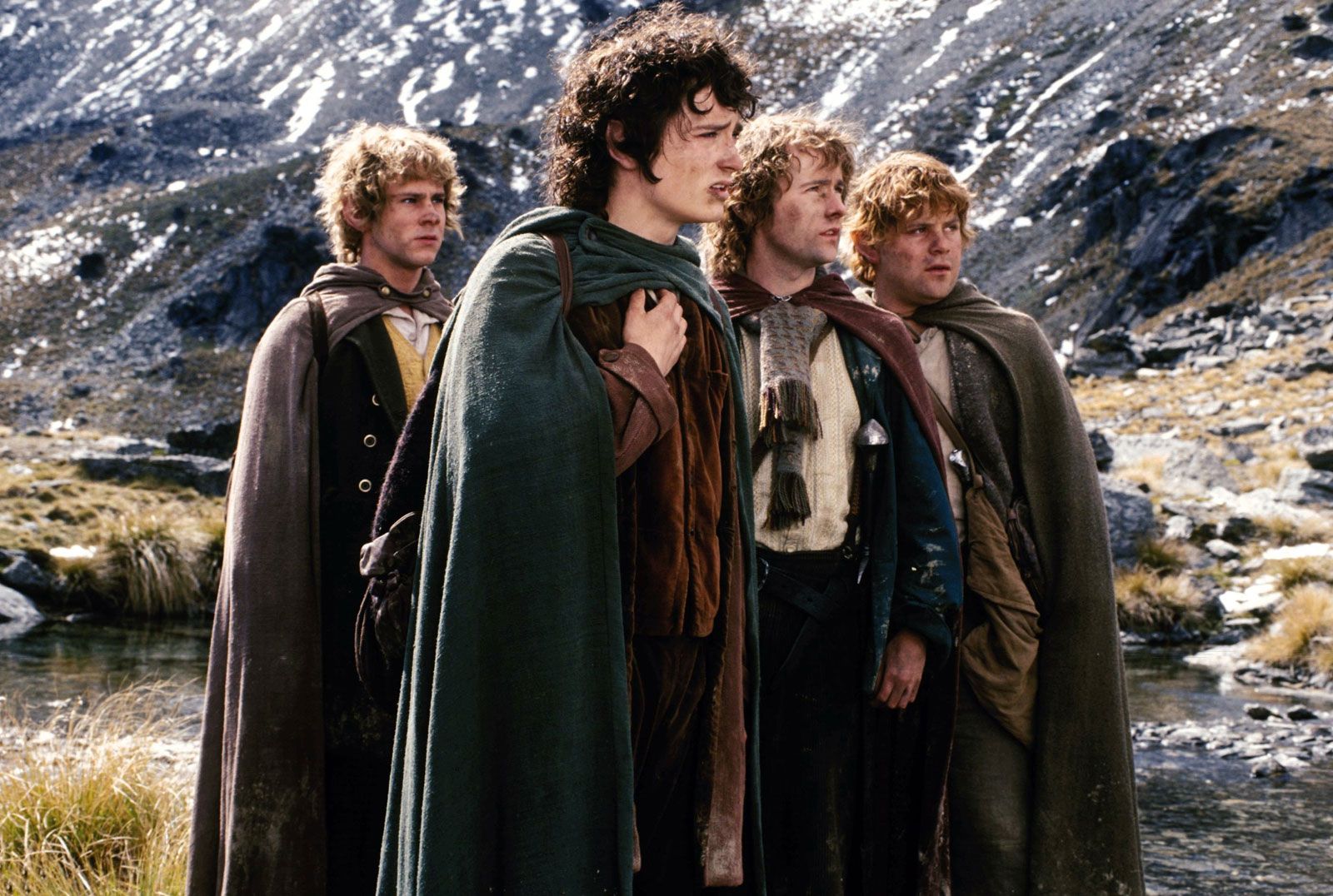
Lord of the Rings extended edition. Around 12 hours to get to Mordor and back.
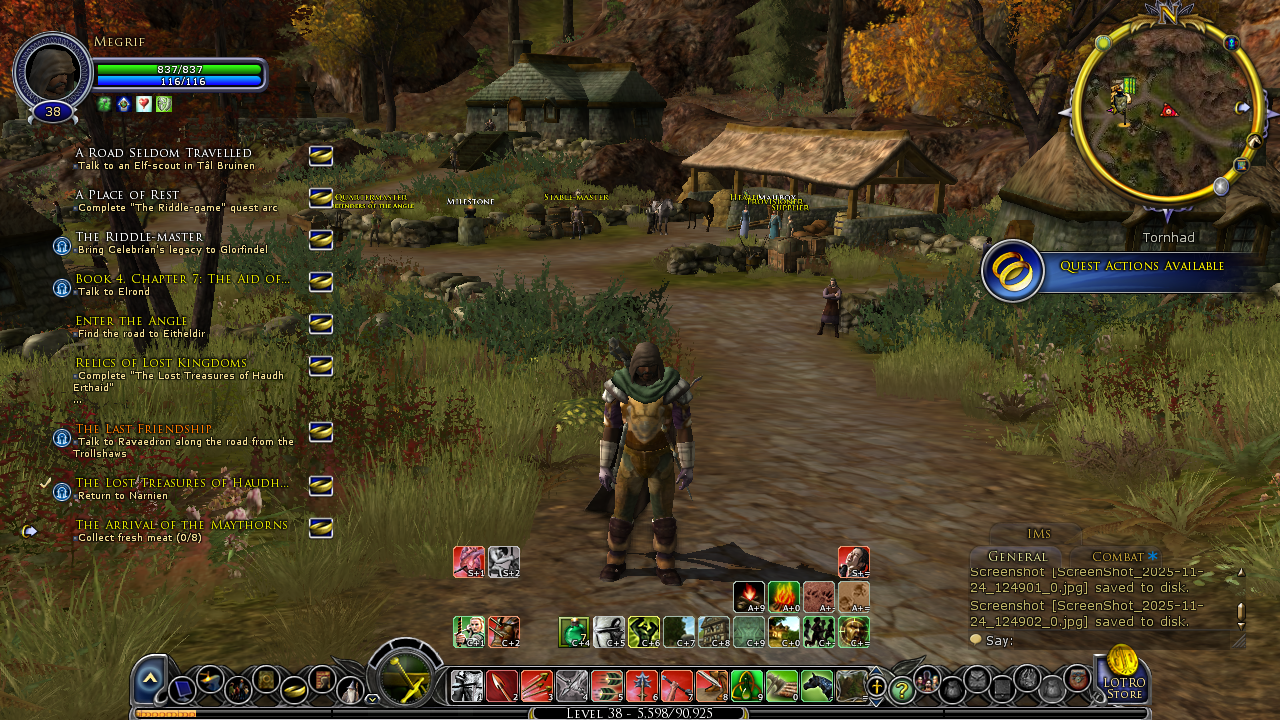
Lord of the Rings Online. 40-50 hours on this character and still doing quests in the Rivendell area.
I hope you’re still with me, because I have to get weirder. The area of thought I’m venturing into is primarily one of abstraction within art. Videogames, and the Toy Towns I opened this essay with, are simulated worlds, in which the contents are what you can see, and what you see are the whole of the contents. Mediums such as books and film are less complete with their representation, relying on the imaginations of the audience to populate their worlds and narratives. These are by no means formal classifications or mutually exclusive, as I could have easily put Film in the former group instead. I merely mean to point to a general distinction.
In addition to the Science Center’s railroad diorama, I owe much of this line of thinking to a discussion-I-had/rant-I-delivered to one of my TTRPG groups, in which I tried to conceptualize how the level of abstraction in text-based media is very malleable. A conversation in a roleplaying game may be handled by speaking in-character, or we might “zoom out” and describe how a character spends an evening hiring pirates in a bar, without worrying about the minutia of exactly what is said. A fistfight could be resolved in a matter of seconds with a single roll of the dice, or we could “zoom in” to track every punch, where it lands and how much it hurts. Point being, the rates in which time passes in-game and in real life are never exactly 1:1, nor should that be the goal.
The root of all of this lies in how we (humans) tell stories. We take a staggering quantity of reality (experiences, memories, facts) and streamline it all into an abstracted narrative that can be shared with others. When I look at Toy Towns, I believe I used to crave more detail, a higher fidelity of representation, a world so perfectly simulated that it would come to life without any need for my imagination to fill in the blanks. But I’ve come to realize that the stumbling points to immersion, whether it’s watching an unbroken 6-month livestream of Frodo walking to Mordor or consulting a chart to calculate the percent chance of a barbarian’s axe decapitating a zombie, comes not from a lack of detail but an overabundance of it. Imagination is not a crutch to overcome, it’s the destination.
My hunger is not for a more accurate reality, but for better stories.
===
EXTRA CREDIT: The construction of Toy Towns is something that has appealed to me just as much as exploring the Toy Towns of others. I’ve always wanted to create some Magnum-Opus-type project, whether it’s a sandbox videogame, massive TTRPG dungeon, or just a big LEGO display. My lack of anything to show for these dreams is caused by the scope of those projects, and the feeling that it just wouldn’t be enough. I think in recent years as I’ve gravitated towards smaller scale projects that actually come to fruition, I’ve always had a subconscious inkling of the conclusions I arrived at in the essay, but I feel more secure in myself having put it into words. I think I want to reshape some of these older projects into small, vignette-sized displays that spark the imagination, and not get bogged down with building all the boring parts too. The goal is to bring people to the dream, not bring the dream to people.